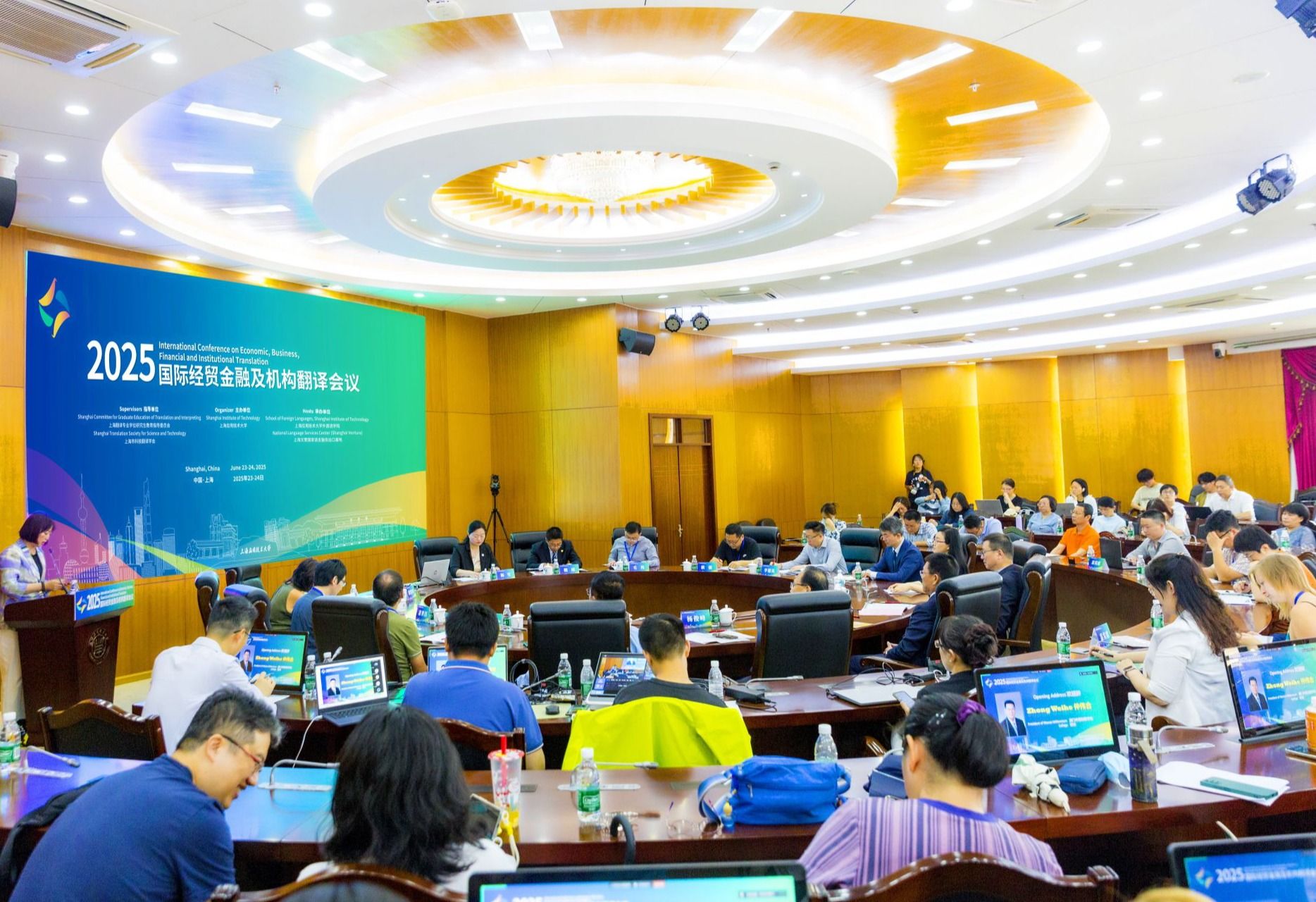
On June 23 and 24, the 2025 International Conference on Economic, Business, Financial and Institutional Translation (ICEBFIT 2025) was held at Shanghai Institute of Technology (SIT), following its 2023 edition in Alicante, Spain. SIT President Wang Xiaofan, Deputy Party Secretary and Vice President Wang Ying, and Vice President Mao Xiangdong attended the conference. It brought together a wide range of experts and scholars from home and abroad to explore the transformation and future of global translation in the age of AI. It was co-hosted by the School of Foreign Languages (SFL), SIT and the National Language Services Center (Shanghai Venture), with SFL Dean Pan Zhidan presiding over the opening ceremony.
The conference was conducted through diverse formats including keynote speeches, expert comments, and parallel sessions. “AI and Translation: Technological Empowerment and Humanistic Persistence” emerged as the first key buzzword of the conference.
In the opening address, SIT President Wang Xiaofan highlighted the critical period of simultaneous AI industrialization and governance, noting that technology implementation and ethical regulation will collectively shape the future of AI. He stressed the principle of balancing humanistic care with technological optimization, stating, “Genuine educational innovation requires both embracing technological change and preserving the humanistic spirit, which is the very purpose of our commitment to technology empowerment and humanistic cultivation.”
Huang Youyi, Executive Vice President of the Translators Association of China, pointed out that the core value of human translation has become even more irreplaceable in addressing vast cultural differences between Chinese and English and in accurately conveying the essence and deeper concepts of Chinese culture.
Professor Zhong Weihe, President of Macau Millennium College, reviewed the development of translation discipline in China and analyzed its current challenges and opportunities. He suggested that future translators will be comprehensive talents who combine language proficiency, cross-cultural competence, and AI application skills.
Professor Hu Kaibao, Assistant President of Shanghai International Studies University, analyzed the current state and challenges of AI in economic, trade, financial, and institutional translation. He indicated that the demand remains high for high-level talents who are bilingual and possess AI literacy.
Centering on the key themes of “Large Language Models and Business Translation Ethics”, “Generative AI Reshaping Financial Translation”, and “AI and Practical Commercial Legal Translation”, Professor Lan Hongjun, Dean of the School of Interpreting & Translation Studies at Guangdong University of Foreign Studies, elaborated that amid the wave of AI technology, critical thinking has become a core competency to ensure translation quality, safeguard cultural diversity, and fulfill ethical responsibilities. Associate Professor Xiao Shichang, Director of GILT Research Centre (Globalisation, Internationalisation, Localisation and Translation) at the Hang Seng University of Hong Kong, categorized translation technologies in the AI era and provided an in-depth analysis of the technical core of large language models.
Professor Li Defeng, Associate Dean of the Faculty of Arts and Humanities at the University of Macau, focused on financial translation pedagogy, proposing a task-driven, process-oriented reflective teaching approach. Professor Zhang Falian, Qian Duansheng Chair Professor at China University of Political Science and Law, emphasized that how different technological entities construct AI technology applications and standardized systems under new circumstances will become a new topic in legal and business translation and communication studies.
Focusing on keywords including “Generative AI Empowering Institutional Translation” and “Government Institutional Translation Practice from Eastern and Western Perspectives”, Professor Qu Wensheng, Qiushi Distinguished Professor at Zhejiang University, argued that AI-assisted translation history research should not be limited to core elements like translated texts, translators, and translation activities. He suggested that “historical research on translation” can also present different facets or be “historical research about translation” based on historical events. Professor Daniel Gallego-Hernández from the University of Alicante conducted a comparative analysis of the financial sectors involved in economic and financial translation publications, revealing commonalities and differences between academic and practical contexts and across continental research traditions.
Professor Geng Qiang, Full-time Researcher at the Institute of Language Sciences at Shanghai International Studies University, proposed that in the big data era, metadata should be considered a fundamental paradigm and methodology in translation history research. Professor Wang Lifei, Dean of the Academy of International Language Services Science, Beijing Language and Culture University, emphasized that enhancing national business translation capacity significantly promotes China’s trade in Knowledge-Intensive Business Services (KIBS), offering insights for advancing business translation competence and education in China.
Chairs and experts, including Professor Yang Junfeng from Dalian University of Foreign Languages, Professor Dong Guangcai, Secretary-General of the Liaoning Provincial Translators Association, Professor Zhang Ailing, Dean of the Graduate Institute of Interpretation and Translation at Shanghai International Studies University, and Professor Han Ziman, Vice Dean of the Institute of Language Sciences at Shanghai International Studies University, provided insightful comments on the keynote speeches, collectively discussing development paths for AI translation.
The conference also included parallel sessions where scholars from China, Australia, Spain, Egypt, France, the Czech Republic, Poland, New Zealand, and other countries engaged in discussions on topics such as “The Role and Ethics of Translators in the AI Era”, “Teaching Applications of Generative AI”, “AI-Assisted Video Subtitle Generation”, and “Translation Quality Assessment”, exploring the application of AI in translation teaching and practice. Discussions also covered practical issues in economic and financial translation, business and legal translation, and tourism translation in the AI era.
In his closing remarks, Vice President Mao Xiangdong noted that in this era of transformation, translation is no longer merely a linguistic technique but an expression of value, a vehicle for culture, and a builder of trust. He looked forward to collaborating with domestic and international colleagues, upholding shared academic pursuits and educational responsibilities, to continue contributing to the development of a responsible, sustainable, and professional translation ecosystem.
Amid the global wave of generative AI, the field of foreign languages faces new opportunities for innovative development. SIT is reshaping translation talent cultivation standards through a three-dimensional framework of technology empowerment, cultural heritage, and value guidance, focusing on training interdisciplinary translation professionals who are not only proficient in AI tools but also deeply rooted in humanistic values. This effort aims to contribute wisdom and momentum for enhancing the international communication impact of China's narrative and empowering the high-quality development of the global translation industry in the AI era.

 沪公网安备31012002003754号 沪ICP备09000134号-1